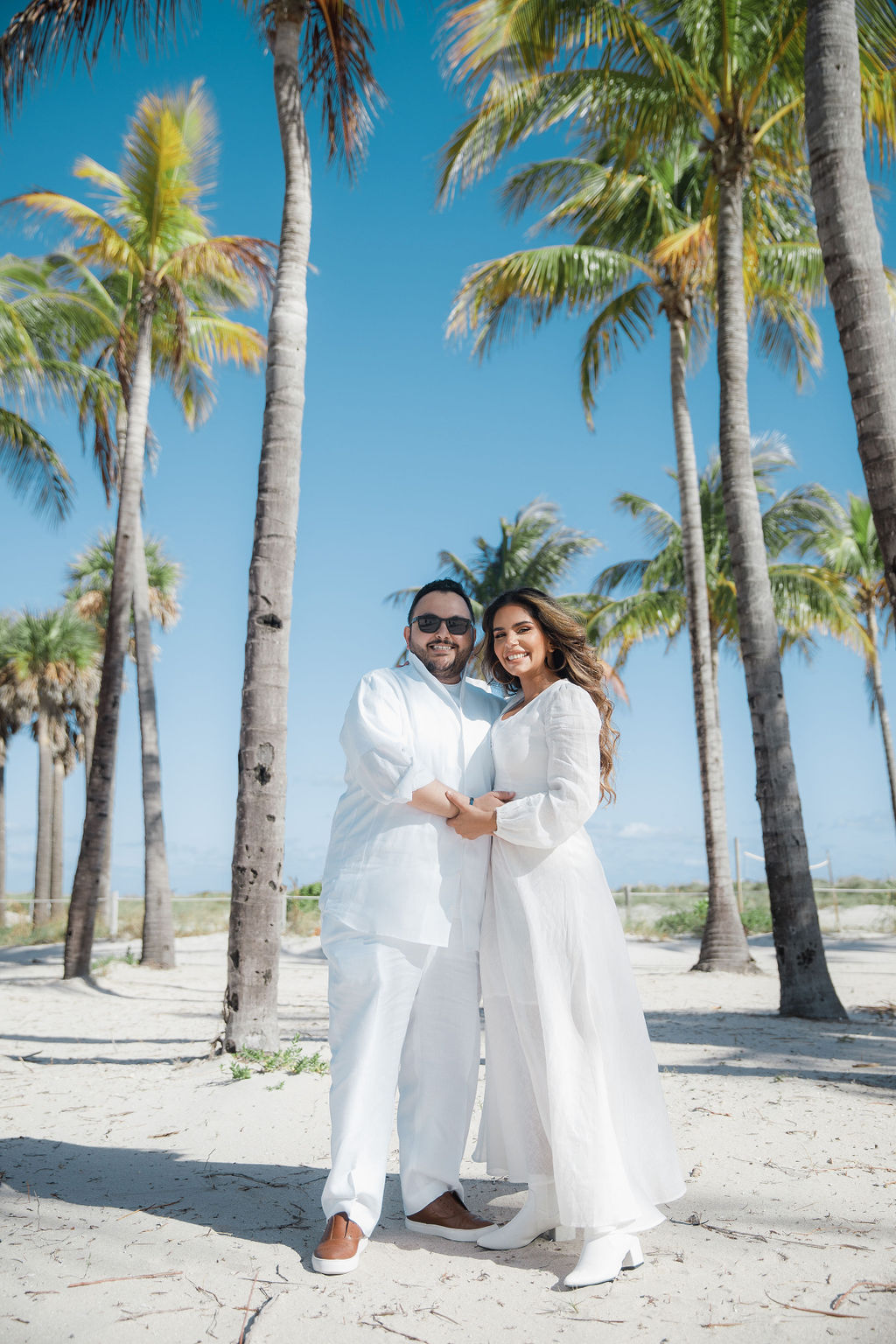
Miami's tropical climate means you can elope any month of the year. That's the good news. The honest news is that each season brings a different set of tradeoffs — humidity, rain, crowd levels, light quality, and hotel pricing all shift dramatically depending on when you show up. I've photographed elopements in every month on the calendar here, and I can tell you that February light and August light are two completely different animals.
This is the month-by-month breakdown I give every couple who asks me "when should we do this?" Real temperatures, real sunset times, and the kind of observations you only pick up after years of shooting in Miami's weather.
The quick answer
November through April is the safest bet. Lower humidity, minimal rain, comfortable temperatures, and the kind of consistent light that makes my job easy and your photos stunning.
But here's what most guides won't tell you: September and October offer hidden advantages for couples willing to be flexible. Fewer tourists, better vendor availability, lower hotel rates, and afternoon storms that clear out fast and leave behind some of the most dramatic skies I've ever photographed. More on that below.
Dry season — November through April
This is peak elopement season in Miami, and for good reason. Humidity drops to manageable levels, rain is rare, and temperatures sit in a range where you can wear a suit or a full-length dress without melting. The air feels different — cleaner, lighter. Skin doesn't shine as much in photos. Hair holds its style. These things matter more than you'd think.
November and December
Average highs sit around 75-80°F with humidity around 65%. Rain is minimal — maybe two or three brief showers all month. November is the sweet spot of the entire year. The summer crowds are gone, the snowbird season hasn't fully ramped up, and the weather is near perfect.
The light in November is low and warm — everything looks golden without trying. Golden hour falls around 5:30-5:45 PM, which means you can start your ceremony at 4:15 PM and have gorgeous light through the entire experience. December is similar but the holiday tourists start arriving after the 15th. If you're planning a December elopement, the first two weeks are ideal.
I shot Tish and Randall's elopement on a November afternoon. The humidity had dropped overnight, the sky was clear, and the light coming off the water was this soft amber that I couldn't have replicated with any equipment. That's what November gives you.
January and February
The driest months of the year. Average highs of 70-75°F, which is the coolest Miami gets — and still warmer than most of the country. Humidity stays low. Rain is almost nonexistent. This is prime beach ceremony weather.
The light in February is especially good. The sun sits lower in the sky, which means golden hour stretches longer and the light wraps around faces in a way that's incredibly flattering. Golden hour runs from about 5:50-6:10 PM. Every skin tone looks amazing in this light.
The catch: this is peak tourist season. South Beach gets crowded, hotel rates climb, and popular venues book out months in advance. If you're planning a January or February elopement, book your vendors and venue at least three to four months ahead. A weekday ceremony helps — Tuesday through Thursday you'll dodge the worst of the crowds.
March and April
Temperatures climb to 75-82°F. Still dry, still comfortable. March brings spring break crowds, especially to South Beach — if you want a quiet beach ceremony, steer clear of the first three weeks of March or head to Key Biscayne instead.
April is quieter and genuinely underrated. The gardens are in peak bloom. Fairchild Tropical Botanic Garden is incredible this time of year — royal poinciana starting to flower, orchids everywhere. If you're considering a garden elopement location, April is when those backdrops are at their most vibrant.
Golden hour extends significantly — 7:15-7:30 PM by late April. That gives you more flexibility with your ceremony timeline. You can start later, take your time with vows, and still have 45 minutes of beautiful light for portraits after.
Wet season — May through October
Higher humidity, afternoon thunderstorms, and the ever-present conversation about hurricanes. But here's the reality: wet season is not a dealbreaker. It requires different planning, not less planning. Some of my favorite photos have come from wet season elopements — the sky does things in summer that it simply doesn't do in winter.
May and June
Temperatures push into the high 80s. Humidity climbs noticeably. Afternoon storms roll in most days between 2:00 and 5:00 PM — they're brief but intense, usually 20-30 minutes of heavy rain followed by clearing skies. The key is timing.
Morning ceremonies before noon usually dodge rain entirely. If you want an afternoon ceremony, plan to start by 5:30 PM after the typical storm window has passed. The air after a summer rain has this quality — everything is washed clean, the light is soft, and colors pop in a way that dry season can't match.
June brings the longest golden hour of the year. Sunset doesn't happen until around 8:15 PM, which means golden light starts around 6:45 PM and stretches for nearly 90 minutes. That's an enormous window for photos.
July and August
The hottest months. Average highs above 90°F with humidity that makes it feel closer to 100. I'm going to be straightforward: midday outdoor ceremonies in July and August are tough. You'll be sweating, your makeup will be working overtime, and I'll be burning through lens cloths trying to keep condensation off my glass.
But sunrise ceremonies? That's a different story. The sun comes up around 6:30-6:45 AM, and those first 90 minutes of light are some of the most beautiful of the year. The air is cooler, the beach is empty, and the light has this soft pink quality that photographs beautifully. Couples who embrace the early morning often tell me it was the most peaceful experience — just the two of them and the ocean.
If sunrise isn't your thing, late evening works too. Start your ceremony around 6:30 PM, catch the tail end of golden hour, and then enjoy the cooler air that comes after sunset. Check my outfit guide for fabric choices that handle summer humidity well.
September and October
Hurricane season peaks in September, and yes, that's the first thing everyone asks about. I'll cover that in detail below. But setting storms aside for a moment — these two months are genuinely underrated for eloping in Miami.
Tourist numbers hit their lowest point of the year. Venues that are booked solid in February have wide-open availability. Hotels drop their rates significantly — sometimes 40-50% below peak season pricing. Your preferred vendors are more likely to be available on your ideal date.
October temperatures start dropping into the mid-80s. The humidity begins to ease. And the sunsets in September and October are among the most vivid of the year — deep oranges, pinks, and purples that look almost artificial in photos but are completely real.
I shot Quinn's elopement on an October evening. We'd been watching a storm system all week that never materialized. The sky was layered with clouds, the light was pushing through in beams, and every single frame had this moody, dramatic quality. She told me afterward that October was their "backup month" after the venue they wanted wasn't available in March. Turned out to be the better choice.
Golden hour timing by month
This is the table I send every couple during planning. Ceremony start times are based on giving you 30 minutes for the ceremony itself plus transition time into portraits during peak golden light.
| Month | Sunset | Best ceremony start | Golden hour quality |
|---|---|---|---|
| January | 5:50 PM | 4:30 PM | Warm low-angle light |
| February | 6:10 PM | 4:50 PM | Soft golden tones |
| March | 7:25 PM | 6:00 PM | Long golden hour |
| April | 7:45 PM | 6:15 PM | Extended warm light |
| May | 8:00 PM | 6:30 PM | Dramatic colors |
| June | 8:15 PM | 6:45 PM | Longest golden hour |
| July | 8:10 PM | 6:40 PM | Rich warm tones |
| August | 7:50 PM | 6:20 PM | Deep golden light |
| September | 7:20 PM | 5:50 PM | Vivid sunset colors |
| October | 6:50 PM | 5:20 PM | Quick but intense |
| November | 5:35 PM | 4:15 PM | Soft and warm |
| December | 5:30 PM | 4:10 PM | Low dramatic light |
The "best ceremony start" column accounts for Miami's latitude. We're far enough south that golden hour is shorter than what you'd experience in, say, Colorado. In December and January, that golden window is only about 20-25 minutes. In June, you get a full hour-plus. Plan accordingly.
Hurricane season — should you worry?
Hurricane season runs June 1 through November 30. That's six months of the year, and if every couple avoided that entire window, Miami's elopement industry would shut down for half the year. It doesn't, because the actual risk is far lower than the fear suggests.
Major hurricanes making direct landfall in Miami are uncommon. The last Category 3+ storm to hit Miami-Dade directly was Andrew in 1992. Tropical storms and weaker hurricanes are more frequent but still only happen a few times per decade.
Modern forecasting gives five to seven days of advance warning for any significant system. That's plenty of time to adjust plans. Your elopement planner monitors weather patterns and has contingency options ready — indoor backup venues, date shifts, or timeline adjustments. I've had exactly two elopements in six years that needed to reschedule due to hurricane threats. Both couples moved their date by three days and had perfect weather.
The practical advice: don't avoid September and October entirely. Do have a flexible backup plan. And do work with a planner who knows how to navigate storm season — it makes all the difference. If you're building your plan from scratch, my 30-day planning guide walks through contingency planning step by step.
Best months for budget-conscious couples
If cost is a major factor in your planning, your best options are May, September, and October. Hotel rates in these months can be 30-50% lower than January through March. Vendor availability is wider, which sometimes means more flexibility on pricing. And venue permits are easier to secure on short notice.
November deserves a special mention. You get dry season weather — genuinely excellent conditions — combined with pre-holiday pricing. Hotels haven't hit their winter peak yet, and many vendors still have their shoulder-season rates in place through mid-November. It's the best value month on the calendar.
For a full breakdown of where your money goes and how to prioritize, check the Miami elopement cost breakdown. The difference between a peak-season and off-season elopement can be $1,500-$3,000 — mostly in hotel and venue costs.
How to plan around Miami's weather
No matter what month you choose, Miami's weather can surprise you. Here's how I help couples prepare.
Morning ceremonies as your secret weapon. In wet season, rain almost always comes in the afternoon. A 9:00 or 10:00 AM ceremony gives you clear skies, softer light, and cooler temperatures. Morning light is different from golden hour — it's cleaner, less warm — but it's beautiful in its own way.
Always have an indoor backup. Even in dry season, I recommend identifying a covered or indoor option within 15 minutes of your primary location. It doesn't have to be a formal venue — a hotel lobby, a covered terrace, even a parking garage with good light can work in a pinch. The best Miami elopement locations guide includes indoor alternatives for each outdoor spot.
What to do if rain is forecast. Don't panic. First, check the hourly forecast — Miami rain is almost always localized and time-specific. A "60% chance of rain" usually means a 60% chance of a 20-minute shower at some point during the day, not six hours of downpour. Second, embrace it if it happens. Some of the most stunning elopement photos I've taken were in the rain. Wet hair, wet streets, reflections everywhere — there's an intensity to rain photos that sunny-day shots can't replicate.
Dress for the season. Lightweight fabrics are non-negotiable May through October. Linen suits, chiffon or crepe dresses, and breathable undergarments make a bigger difference than you'd expect. I cover fabric recommendations in detail in the Miami elopement outfit guide.
Frequently asked questions
What is the best month to elope in Miami?
November. It gives you the best combination of weather, light quality, manageable crowds, and reasonable pricing. Temperatures around 78°F, humidity around 65%, almost no rain, and golden hour light that's warm and low without being harsh. If November doesn't work with your schedule, February is the next best option — drier and slightly cooler, though you'll pay more for hotels and need to book further in advance.
Can you have a beach wedding in Miami in the summer?
Yes, but plan around the heat. Sunrise ceremonies between 6:30 and 8:00 AM are your best bet — cooler air, empty sand, soft light. Late evening ceremonies starting around 6:30 PM also work well once the worst of the heat passes. Avoid anything between 11:00 AM and 4:00 PM. Bring water, have shade available, and wear lightweight fabrics. Your photographer will thank you.
What time is golden hour in Miami?
It shifts significantly throughout the year. In winter (December-January), golden hour starts around 5:00 PM with sunset at 5:30-5:50 PM — it's short but intense. In summer (June-July), golden hour begins around 7:00 PM with sunset at 8:10-8:15 PM — a much longer, more gradual window. The table above has exact times for each month. I always recommend starting your ceremony 60-80 minutes before sunset to get the full range of light.
Is hurricane season a bad time to get married in Miami?
Not inherently. Hurricane season spans June through November, but the statistical chance of a major storm disrupting your specific date is low. Modern weather forecasting provides nearly a week of advance notice. The real question is your risk tolerance and flexibility. If you can be somewhat flexible with your date (even by two to three days), September and October elopements offer significant savings and some of the most dramatic skies of the year. Work with a planner who has storm-season experience and backup plans in place.
What's the cheapest time to elope in Miami?
September and October offer the lowest overall costs. Hotel rates drop 30-50% from peak season, vendors have more availability (and sometimes lower rates), and venue permits are easier to secure. May is also budget-friendly. For the best balance of affordability and weather, target the first two weeks of November — pre-holiday pricing with dry-season conditions. A full cost analysis is in the Miami elopement cost breakdown.